
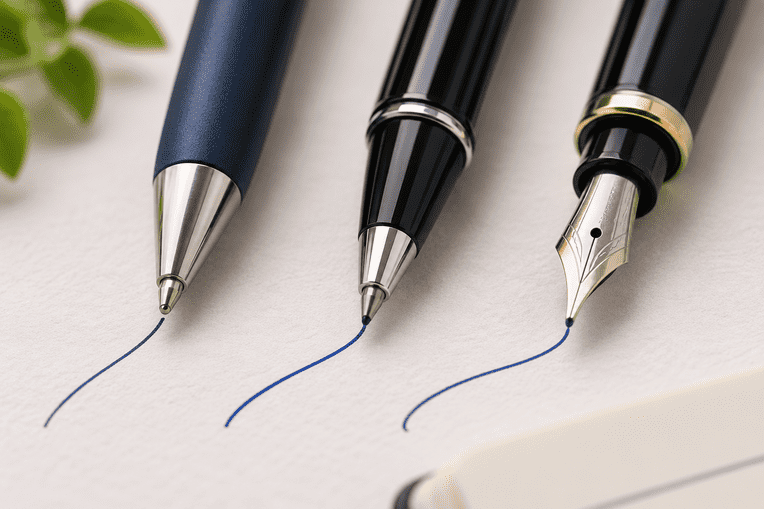
Write the same sentence with a ballpoint, a rollerball and a fountain pen. The ballpoint feels controlled and familiar. The rollerball tends to glide with a lighter touch. The fountain pen depends more noticeably on the nib, ink and paper. None is automatically better: the right choice follows what you write, where you write and who will use it.
In short: a ballpoint usually delivers thicker oil-based ink through a tiny rolling ball. A rollerball uses a similar tip but typically has more fluid water-based ink, sometimes a gel formulation. A fountain pen feeds liquid ink through a nib. This affects writing pressure, line appearance, drying time and upkeep.
Ballpoint vs rollerball vs fountain pen: what’s the difference?
All three put ink on a page, but they behave differently in a hurried meeting, on thin paper or during a long handwritten note. The table gives typical tendencies, not rules that apply to every pen and refill.
| Feature | Ballpoint | Rollerball | Fountain pen |
|---|---|---|---|
| Ink delivery | Small rolling ball; generally more viscous oil-based paste | Rolling ball; usually more fluid ink or gel | Feed and split nib; liquid fountain-pen ink |
| Writing feel | Typically firmer, with some pressure | Often smoother with a lighter touch | Light touch, shaped by nib, ink and paper |
| Drying and smudging | Often quick to handle | May need longer to dry | Varies significantly by ink and paper |
| Thin paper | Generally more forgiving | Some inks can feather or show through | Some inks can feather or bleed through |
| Refilling and care | Replace the refill or pen | Replace the compatible refill; keep capped where required | Replace cartridge or refill converter; clean the feed periodically |
| Everyday fit | Forms, fast notes and shared desks | Letters and longer writing sessions | Personal writing and considered gifts |
There is overlap. Some modern ballpoints are exceptionally smooth; a quick-drying fountain-pen ink may smudge less than a wet rollerball on the right paper. Try the actual pen and refill rather than judging by the category name alone.
When is a ballpoint pen the best choice?
Think of a pen that lives beside a reception log, in a jacket pocket or at the end of a conference table. It needs to write immediately, tolerate everyday handling and cope with whatever paper is available. That is where a ballpoint generally earns its place.
Its more viscous ink usually dries quickly on the page and is less prone to bleeding through thin office paper. The trade-off is that some models need more pressure than a rollerball. That extra pressure makes a conventional ballpoint particularly useful for carbonless duplicate forms, where writing must also mark a sheet underneath.
For everyday branded stationery, the personalised pens range is the broadest starting point. Familiar formats include BIC pens and Prodir pens; a stylus pen can suit people who move between notebooks and touchscreens.
Tip size, refill quality, ink formulation and barrel shape matter as much as the label. A comfortable grip may be more valuable for regular note-taking than an expensive finish.
What is a rollerball pen, and how does it differ from a ballpoint?
A rollerball still has a tiny ball at its writing tip. The important change is the ink: it is generally more fluid, so the pen tends to make a darker line with less hand pressure. For someone writing several pages of notes, that lighter feel can be appealing.
There is a compromise. Wetter ink can take longer to set, particularly on coated paper, and may feather on absorbent paper. If you are left-handed and your hand passes over fresh writing, ink formulation and drying speed are especially worth testing. A quick-drying refill may work better than a particularly wet one.
Gel pens are worth mentioning here: they also use ball tips, but gel ink is its own formulation, and products may be labelled differently by manufacturers. Judge the particular refill rather than assuming every gel pen behaves like a liquid-ink rollerball.
Rollerballs often appear in paired writing sets alongside ballpoints. Loopper lists a Cross ballpen and roller set among its personalised business pens; check the live product options and availability when ordering.
Is a fountain pen worth choosing?
A fountain pen asks you to slow down a little. Instead of a rolling ball, it uses a nib and feed to deliver ink from a cartridge, converter or other reservoir. It should write with little downward pressure; the result depends on the nib width, ink and paper as well as the writer.
That more deliberate feel is part of its appeal, but it comes with routine care. Fountain pens benefit from occasional cleaning, particularly when changing inks or leaving a pen unused. Some inks bleed on thin paper, and a fountain pen should be carried with the cap secure. During flights, changes in air pressure can encourage leakage, depending on the pen and how it is filled; follow the manufacturer's travel guidance.
Unlike a shared desk pen, this is often a personal object. A well-chosen fountain pen can be kept, refilled and used over time. Loopper lists fountain-pen models among its Parker pens and Waterman pens. Whether a name or logo can be engraved depends on the particular barrel and finish.
A note for left-handed writers: there is no universally best pen type. Consider how your hand crosses the page, the nib or tip width, the ink's drying time and the paper. Left-handed fountain-pen users can write comfortably with a suitable combination.
Which pen should you choose for your business?
The question changes when you are choosing a pen for somebody else. A pen distributed at a public event needs to be easy to use straight away; a personal thank-you can invite a more considered choice. The most effective decision starts with the recipient's likely routine, not with the most luxurious pen in the catalogue.
For busy desks and events
Choose a reliable ballpoint with a comfortable grip, a clear imprint area and a refill suitable for general office paper.
For meetings and regular note-takers
Consider a smooth rollerball or higher-quality ballpoint, ideally tested alongside the notebook people will actually use.
For a personal business gift
A fountain pen or boxed writing set can feel more individual, provided the recipient is likely to enjoy using and maintaining it.
There is a practical branding question too: a small pen barrel has limited room for artwork. For a narrow curved surface, a compact mark is often clearer than a long slogan. The printing techniques guide helps explain how decoration methods work, while an A5 notebook can make sense when the pen is part of a writing kit.
And if you are comparing recycled or lower-impact materials, look at the eco pen options individually. A material label alone does not establish how long a particular pen will last or whether its refill can be replaced.
Further reading


Marketing team, Loopper
Wissam writes about promotional products, printing and how everyday objects fit into working life.
 Content reviewed by Lars Rud, Marketing Manager at Loopper


