
There is something satisfying about leaving a shop with a cotton tote rather than another thin plastic carrier. It feels like the responsible thing to do. But what if the tote is the fifth one at home, folded beneath four others?
Producing a reusable bag uses resources too. That does not make cotton the villain or plastic the solution. It does mean that a tote bag's environmental story continues long after the checkout. For brands choosing a bag to give away, the better question is not simply Which bag looks green? It is Will someone actually use this one?
How many times do you need to use a tote bag?
A much-quoted figure is 131 uses. It comes from a UK Environment Agency life cycle assessment published in 2011, using supermarket carrier-bag data from 2006. Its researchers modelled how often different bag types would need to be used for their global warming potential to fall below that of a conventional lightweight high-density polyethylene (HDPE) carrier bag.
The result for the cotton bag changed depending on what happened to the plastic comparison bag. If the plastic carrier was used again as a bin liner, it displaced another item, so the cotton bag needed more shopping trips to outperform it in that particular climate calculation.
One cotton bag, three different comparisons
Modelled number of primary uses needed for lower global warming potential than the specified HDPE carrier scenario.
Source: Environment Agency (2011), executive summary, comparison table. Figures refer to modelled global warming potential, not every environmental impact.
These are not universal break-even points for every modern tote bag. The study did not model all branded bags, used historic data and explicitly excluded littering, changes in consumer behaviour and their potential effects. Bag size, fabric, manufacturing and real-world reuse also vary. Nor does a climate-only figure tell us everything about waste, water use or impacts on wildlife.
A Danish Environmental Protection Agency assessment published in 2018 considered a broader range of environmental indicators and reached different material comparisons. Some widely repeated headline reuse numbers from that report depend heavily on the indicator and assumptions selected; they should not be presented as one universal answer. The more practical conclusion is simpler: avoid acquiring extra bags when the ones you already have can do the job.
What should you take away from the 131-use number? It shows why repeat use matters within a specific climate-impact comparison. It does not prove that every cotton tote is worse than plastic for its first 130 trips, nor that 131 uses makes any particular bag fully “sustainable”.
Which tote bag materials have a lower environmental impact?
There is no guaranteed winner across every measure. Growing fibres, producing yarn, dyeing cloth, printing logos and transporting finished bags all carry impacts. Recycled content may reduce demand for virgin material, while other choices change land use, water needs or end-of-life options. A good comparison asks lower impact in which category, compared with what?
| Material | Potential benefit | What still needs checking |
|---|---|---|
| Recycled cotton | Can substitute recovered textile fibre for some newly grown cotton | Actual recycled percentage, strength, blend and certification of the specific bag |
| Organic cotton | Farming is subject to organic production standards rather than conventional synthetic-input practices | Land and water impacts, production location and whether a credible certification covers the product |
| Jute | Plant-based fibre that can be used for robust, structured bags | Coatings, linings, handle materials, manufacturing and how often the bag is reused |
| Recycled polyester (rPET) | Uses recovered polyester as an input and can suit compact, foldable carriers | Percentage of recycled material, plastic fibre shedding, coatings and end-of-life route |
A certification can help substantiate a precise claim, but it is not a blanket badge proving a bag has the smallest footprint. Loopper's eco bags range includes bags described with recycled content and some with certification details. Check the specific product and supporting documents: a GRS claim on one listed bag cannot be transferred to every recycled cotton tote. Other places to compare options include eco-friendly cotton bags, jute bags and rPET products.
The material also needs to suit the job. A reusable shopping bag is not necessarily an efficient choice for a one-off handout, while a flimsy bag that splits after a handful of uses defeats the purpose of making something reusable. For an explanation of canvas, lightweight cotton, jute and fabric weight, see our related guide, What's the Best Fabric for Tote Bags?.
How can brands make a tote bag worth keeping?
Imagine a bag someone actually reaches for before leaving home. The straps sit comfortably on the shoulder. The base fits everyday shopping. The print still looks good after repeated use. That is a more useful design brief than simply asking for the greenest-sounding material.
Make it useful
Match the size, handles, seams and fabric to the expected contents. Check the listed load guidance when available, rather than assuming thickness alone guarantees strength.
Make it desirable
A thoughtful colour and well-positioned design may fit more wardrobes and routines than an oversized sales message. This is editorial design advice, not measured proof of higher retention.
Make only what is needed
Estimate genuine take-up before placing an order. A stockroom full of untouched giveaways represents material already used for no practical benefit.
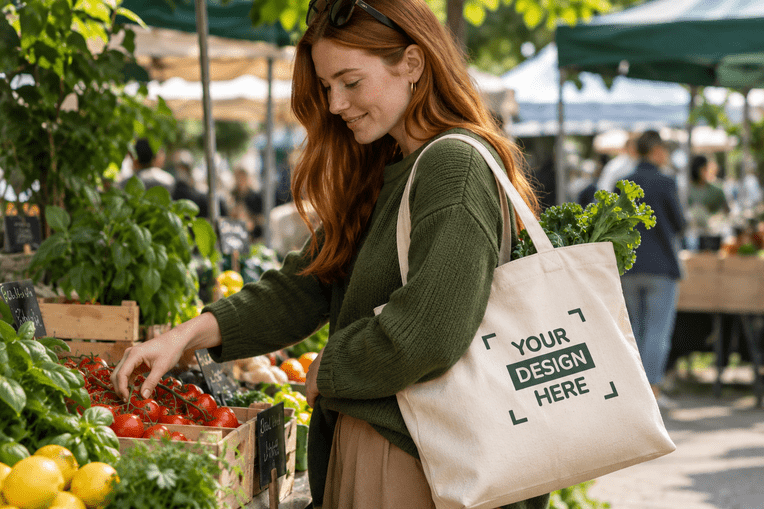
The most appropriate bag may be one that folds away and comes back out at the next shop. See foldable shopping bags for that use case, or compare personalised tote bags if you need a more structured carrier. When a bag is unlikely to be reused, question whether a new bag needs to be produced at all; switching to paper does not automatically mean a lower total impact.
Care and disposal should follow the actual bag's label and construction. Printed textiles, mixed materials and coatings can affect washing and recycling options. Where a bag remains usable, reuse or passing it on is often the first route to consider; ask a local textile collection service what it accepts instead of assuming every cotton tote is recyclable in a household bin.
Can you call a tote bag eco-friendly in your marketing?
“Eco-friendly” sounds reassuring, but it leaves a lot unanswered. What exactly is better: recycled content, farming methods, packaging, or a measured environmental footprint? And compared with which alternative?
The UK's Competition and Markets Authority explains in its Green Claims Code that environmental claims should be accurate, clear, not omit relevant information, make fair comparisons, take the product life cycle into account and be substantiated. Its January 2026 supply-chain guidance also addresses the responsibilities of brands, retailers and suppliers involved in making those claims. The Green Claims Code is framed around consumer protection; the precise legal position for any particular B2B communication should be reviewed separately.
Prefer a specific, checkable description. For example, “contains 70% certified recycled cotton” is meaningful only if that precise percentage and certification are evidenced for the actual product. “Planet-friendly bag” offers little information and can imply far more than the supplier can substantiate.
Before approving branded merchandise, ask the supplier for the composition, any certificate applying to that product and its scope, available durability specifications, and printing details. A certified material does not automatically certify the entire finished printed bag. You can ask the Loopper team about documentation for a particular design.
For businesses, the question therefore has two parts: can we explain why this bag is a suitable choice? And have we designed and distributed it in a way that makes continued use plausible? The first needs evidence. The second needs understanding of people and the situations in which they carry a bag.
Further reading


Marketing team, Loopper
Wissam writes about promotional products, material choices and how branded objects fit into everyday routines.
 Content reviewed by Lars Rud, Marketing Manager at Loopper
Sources and further detail
- Environment Agency (2011): Life cycle assessment of supermarket carrier bags (2006 data)
- CMA: Green Claims Code — making environmental claims on goods and services
- CMA (22 January 2026): Making green claims across the supply chain
- Loopper UK: eco bags — individual product descriptions and specifications


